The Quiet Part
If you follow Apple keynotes, you'd be forgiven for thinking gaming is still an afterthought. There are no "One More Thing" moments for game compatibility. No stage demos of Helldivers 2 running on a MacBook. No Phil Spencer-style developer courtship campaigns.
But if you look at what Apple is actually building — the tools, the frameworks, the infrastructure — the picture is very different. Apple is investing in gaming more seriously than at any point in its history. They're just doing it the Apple way: quietly, on their own terms, and with a long-term play that extends far beyond the Mac.
Apple Games: The Foundation
The most visible signal of Apple's gaming ambitions is Apple Games — the dedicated gaming app that launched across macOS, iOS, iPadOS, and tvOS. This isn't just a renamed section of the App Store. It's a purpose-built storefront and launcher designed to make gaming a first-class experience on every Apple device.
Apple Games does something no other platform can match right now: cross-device gaming across an entire hardware ecosystem. Buy a game once, and it works on your iPhone, iPad, Mac, and — in the near future — Apple TV. Your saves sync. Your progress carries over. The experience is seamless in a way that Steam, Epic, or Xbox can't replicate across this many form factors.
Death Stranding: Director's Cut is one example. Buy it through the App Store and play on your iPhone during a commute, pick it up on your iPad on the couch, and continue on your Mac at your desk. It even runs on low-end hardware like the MacBook Neo and iPhone, which shows that optimization — not just raw power — is a major focus for Apple and its porting partners. That's a genuine value proposition that no Windows-centric platform offers.
The Technology Stack: What Apple Is Building
Underneath the consumer-facing app, Apple has been assembling a serious technology stack for gaming. Some of this is public. Some of it is less obvious.
Metal 4
Metal is Apple's proprietary graphics API — their answer to DirectX and Vulkan. Metal 4, which shipped with macOS Tahoe, represents a major leap in capability. It brings improved ray tracing support, mesh shading, and performance optimizations that directly benefit both native games and translation layers.
Metal 4 is the foundation that everything else is built on. Every game running on an Apple device — native or translated — goes through Metal. The better Metal gets, the better everything runs.
Game Porting Toolkit (GPTK)
We've covered GPTK in detail before. It's Apple's developer tool that makes it dramatically easier (and cheaper) to bring Windows games to Mac. Under the hood, it's built on Wine and includes D3DMetal for DirectX-to-Metal translation.
GPTK isn't a consumer product — it's a developer tool. But it's critical because it lowers the barrier for studios to port their games. Instead of rewriting a game's entire rendering pipeline, developers can use GPTK to get a working Mac version with far less effort. Many of the recent AAA ports on the App Store likely went through some version of this pipeline.
D3DMetal
D3DMetal is Apple's DirectX-to-Metal translation layer that ships inside GPTK and is also used by CrossOver. It translates DirectX 11 and DirectX 12 calls into Metal API calls in real time. As of version 3.0 (bundled in CrossOver 26), it has reached a level of maturity where demanding AAA games run with genuinely playable performance.
Apple develops D3DMetal internally. That's significant — it means Apple is directly investing engineering resources into making Windows game technology work on their platform. This isn't something a company does if gaming is just a marketing bullet point.
DXMT
DXMT is an alternative DirectX-to-Metal translation layer that complements D3DMetal. While D3DMetal is Apple's own project, DXMT originated from community efforts and provides an alternative translation path that performs better for certain titles. Both layers are available in tools like CrossOver and Sikarugir, giving users flexibility to pick the best performer for each game.
The fact that there are now two actively maintained DirectX-to-Metal translation layers — and that Apple contributes to this ecosystem — speaks to how much momentum the Mac gaming translation space has gained.
The AAA Port Pipeline
Talk is cheap. Technology stacks are meaningless without games. So let's look at what's actually shipping.
Apple has been actively hosting AAA game ports on the App Store, and the list has grown substantially:
| Game | Studio | Platforms via Apple |
|---|---|---|
| Death Stranding: Director's Cut | Kojima Productions / 505 Games | Mac, iPhone, iPad |
| Resident Evil Village | Capcom | Mac, iPhone, iPad |
| Resident Evil 4 (Remake) | Capcom | Mac, iPhone, iPad |
| Assassin's Creed Mirage | Ubisoft | Mac, iPhone, iPad |
| Assassin's Creed Shadows | Ubisoft | Mac, iPhone, iPad |
| Lies of P | Neowiz / Round8 Studio | Mac, iPhone, iPad |
| No Man's Sky | Hello Games | Mac |
| Baldur's Gate 3 | Larian Studios | Mac |
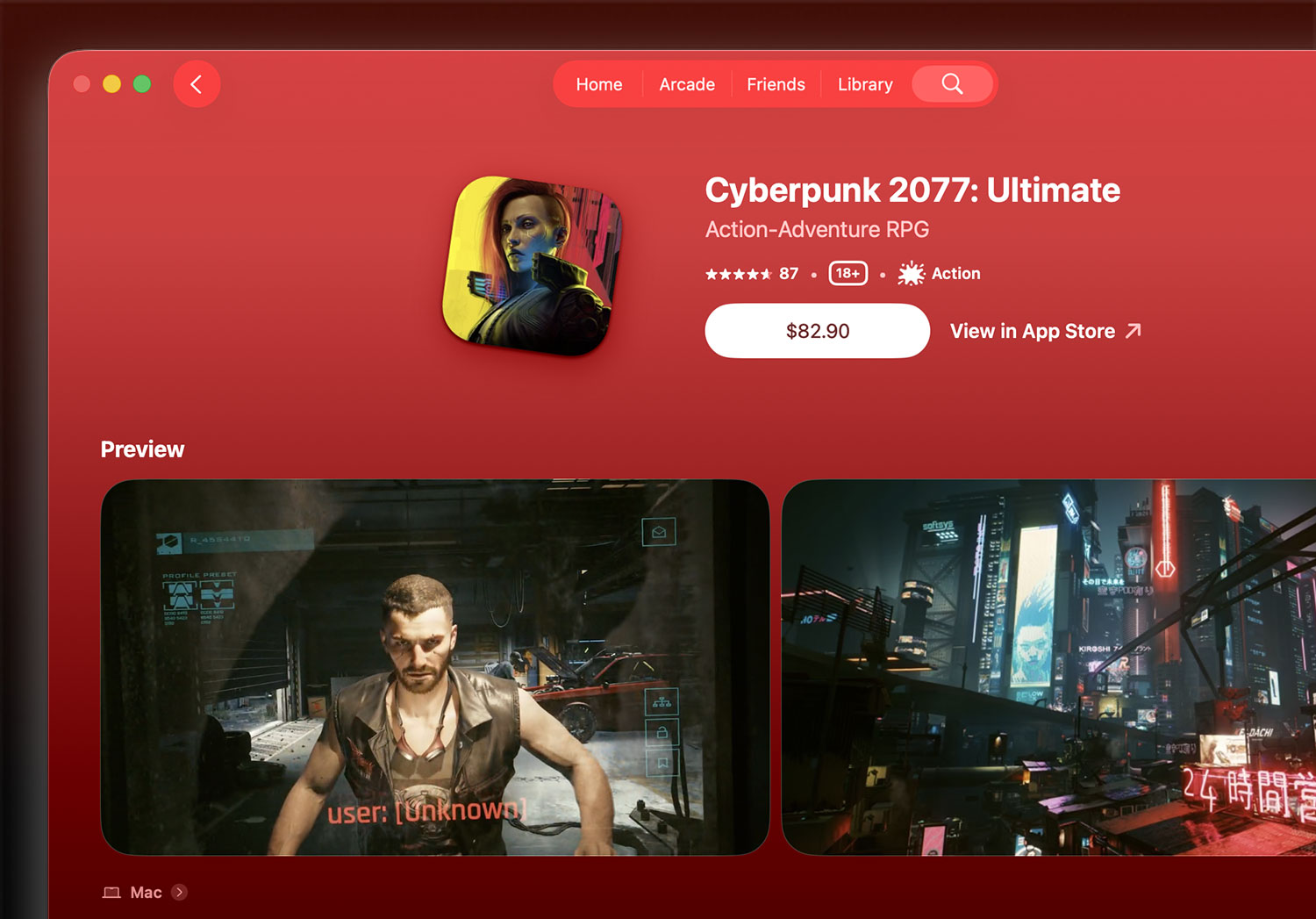
| Cyberpunk 2077 | CD Projekt Red | Mac |
| Control: Ultimate Edition | Remedy / 505 Games | Mac, iPhone, iPad |
| Palworld | Pocketpair | Mac |
This is a far cry from the Mac gaming landscape even two years ago. These aren't indie titles or five-year-old ports — they're current-generation AAA games running natively on Apple hardware.
And crucially, many of these aren't just Mac ports. They're cross-device releases that work on iPhone and iPad too, which is the Apple Games value proposition in action.
What About Steam?
Here's the elephant in the room. Most PC gamers already own their libraries on Steam. Having a game available on the App Store through Apple Games is great for new buyers, but what about the millions of people who already own these titles on Valve's platform?
Some titles are already available on both. Cyberpunk 2077, for example, has a native Mac version on Steam — if you already own it, you can download and play it on your Mac without repurchasing. That's the ideal scenario.
But not all of them are. Death Stranding, for instance, only offers the Windows version on Steam. If you want the native Mac (and iPhone/iPad) version, you have to buy it again through the App Store. The same goes for the Resident Evil titles and several other marquee ports.
We hope this changes in the future so gamers have a real choice: buy the game on Steam to keep it in their Steam library and take advantage of that ecosystem, or get it through the App Store to play across all their Apple devices. Both options have clear value — and ideally, players shouldn't have to pick one storefront just because the native Mac build is exclusive to it.
The Cross-Device Advantage
One thing Apple has that nobody else does: a unified hardware ecosystem spanning phones, tablets, laptops, desktops, and TV set-top boxes.
When a game is built for Apple Games, it can potentially run on all of those devices. Death Stranding on your iPhone. Resident Evil 4 on your iPad. The same save, the same purchase, everywhere.
Steam can't do this. Xbox comes close with PC-to-console play, but doesn't extend to phones and tablets. PlayStation is locked to consoles and a limited PC catalog. Only Apple has the hardware reach to offer true play-anywhere across this many device categories.
With Apple TV gaining gaming capabilities and the Apple Games app serving as a unified launcher, it's not hard to imagine where this is heading: Apple positioning itself as a casual-to-core gaming platform that lives in your pocket, on your desk, and in your living room — simultaneously.
Connecting the Dots
Let's put all of this together:
- Apple Games — A dedicated gaming storefront across all Apple devices, with cross-device purchases and cloud saves.
- Metal 4 — A graphics API that's now competitive with DirectX and Vulkan for game rendering, with ray tracing and mesh shading support.
- GPTK — A developer tool that makes porting Windows games to Mac dramatically easier and cheaper.
- D3DMetal — Apple's own DirectX-to-Metal translation layer, actively developed and shipped to developers, now at version 3.0.
- DXMT — A complementary translation layer providing an alternative pipeline for titles that benefit from it.
- AAA ports pipeline — A growing catalog of current-gen games arriving natively on Mac, iPhone, and iPad.
- Apple Silicon — Hardware that's powerful enough to run these games, with unified memory architectures that suit gaming workloads.
Individually, any one of these could be dismissed as incremental. Together, they form a coherent strategy. Apple is building the entire vertical stack for gaming — hardware, graphics API, translation tools, developer aids, and distribution — all under one roof.
What's Still Missing
It wouldn't be a reality check without the reality. There are still real gaps:
- Steam distribution for native ports — As discussed, locking AAA ports to the App Store limits adoption. Gamers want to use their existing libraries.
- Developer communication — Apple is famously tight-lipped. Compare this to Valve, which openly shares Proton compatibility data, hosts developer forums, and publishes regular Steam Deck compatibility reports. Developers and users alike would benefit from Apple being more transparent about their gaming roadmap.
- Anti-cheat support — While CrossOver 26 made breakthroughs on the compatibility layer side, native anti-cheat support on macOS remains limited. Many competitive multiplayer titles still can't run on Mac at all, even natively.
- The port catalog is still small — A dozen AAA titles is a great start. It's not a platform. Apple needs the pipeline to grow from "notable exceptions" to "expected standard" before Mac is taken seriously as a gaming platform by the broader market.
- Public commitment — Apple has never explicitly stated "we are building a gaming platform." The ambiguity leaves developers uncertain about how long this investment will last. A clear, public commitment would go a long way.
The Bottom Line
Is Apple serious about gaming? Based on the evidence — yes. More serious than they've ever been.
They're not doing it the way Microsoft or Sony does it. There are no Game Pass-style subscription pushes, no exclusive studio acquisitions, no gaming-focused press conferences. Instead, Apple is building infrastructure: the graphics API, the translation tools, the developer pipeline, the cross-device distribution platform, and the hardware to power all of it.
The results are already showing up. AAA games are arriving natively on Mac, iPhone, and iPad. The compatibility layer ecosystem — powered in part by Apple's own D3DMetal — is running more Windows games than ever. And the cross-device promise of Apple Games is something genuinely unique in the industry.
The biggest risk is Apple's own silence. Gaming communities thrive on hype, roadmaps, and developer engagement. Apple offers none of that. If they want gaming to succeed on their platform, they'll eventually need to meet developers and players halfway — not just build great tools, but also talk about them.
For now, though, the trajectory is clear. If you're gaming on a Mac in 2026, you have more options than at any point in Apple's history — and it's only going to get better from here.
Take Advantage of It Today
If you want to take advantage of everything Apple and the community have been building — D3DMetal, DXMT, Wine 11, Metal 4 — you don't need to be a developer or compile anything yourself. CrossOver packages all of these technologies into a friendly app with a guided setup wizard. Point it at a Windows game, and CrossOver handles the rest — translation layers, configuration, and optimization — so you can just play.
It's the easiest way to tap into the full Mac gaming stack right now, whether you're running AAA titles that need the latest anti-cheat fixes or older favorites from your Steam library.
Get CrossOver (15% off with code WINEFORMAC15)
Or try the 14-day free trial to test your games first.
Sources
- Apple Inc. Apple Games. apple.com/apple-games
- Apple Inc. Game Porting Toolkit. developer.apple.com/game-porting-toolkit
- Apple Inc. Metal. developer.apple.com/metal
- WineForMac.org. Understanding Apple's Game Porting Toolkit. wineformac.org
- WineForMac.org. CrossOver 26 Breaks the Anti-Cheat Barrier. wineformac.org